Cervicogenic Headache: Differential Diagnosis and Treatment
Cervicogenic headache is a secondary headache in which pain perceived in the head is in fact referred from a disorder of the cervical spine, most often the upper cervical segments.
Cervicogenic headache is a secondary headache in which pain perceived in the head is in fact referred from a disorder of the cervical spine, most often the upper cervical segments. It is frequently mistaken for a primary headache, and the consequence of misdiagnosis is treatment directed at the wrong target. Because the cervical source is amenable to physical treatment, accurate identification carries direct therapeutic value. This article describes the clinical presentation of cervicogenic headache, the features that distinguish it from migraine and tension-type headache, the role of the cervical flexion-rotation test, and the evidence guiding treatment.
What Is Cervicogenic Headache?
Cervicogenic headache arises from the bony structures or soft tissues of the neck and is referred to the head or face. The anatomical basis lies in the convergence, within the upper cervical spinal cord, of sensory fibres from the upper cervical nerve roots and the trigeminal nerve. This region, sometimes termed the trigeminocervical nucleus, is where nociceptive input from the upper three cervical segments and from the trigeminal system meet, and it is this convergence that allows pain signals originating in the upper cervical segments to be perceived in the territory of the trigeminal system, which is to say in the head and face. The pain is typically unilateral and side-consistent, begins in the neck, and radiates toward the frontotemporal region; it may also be felt around the eye or referred into the ipsilateral shoulder and arm. It is commonly provoked by neck movement or by sustained awkward postures and is associated with reduced cervical range of movement. Underlying contributors include degenerative change, prior neck injury such as whiplash, and sustained occupational postures, including those of work that demands prolonged neck flexion or static positioning.
How Is Cervicogenic Headache Diagnosed?
The diagnosis is clinical and rests on demonstrating that the headache can be attributed to a cervical source. The criteria of the International Classification of Headache Disorders require evidence of a disorder or lesion within the cervical spine or its soft tissues known to be capable of causing headache, together with evidence of causation. Causation may be demonstrated by the headache developing in temporal relation to the onset of the cervical disorder, by its improvement or resolution in parallel with treatment of the cervical disorder, by reduced cervical range of movement with the headache worsening on provocation, or by abolition of the headache following diagnostic blockade of a cervical structure or its nerve supply. The headache must not be better accounted for by another diagnosis. Notably, imaging of the cervical spine is not sufficiently specific to confirm cervicogenic headache, because degenerative findings are common and frequently asymptomatic.
How to Distinguish Cervicogenic Headache From Migraine and Tension-Type Headache?
The differentiating factors of each of these pains include:
Cervicogenic headache:
- Unilateral and side-locked, which does not switch sides between or during attacks.
- Begins in the neck or occiput and refers forward to the fronto-orbital region.
- Provoked by neck movement, sustained posture, or pressure over the upper cervical segments.
- Deep, dull, and non-throbbing, of moderate intensity.
- Accompanied by reduced cervical range of motion and a positive flexion-rotation test, the pain can be mechanically reproduced on palpation of C1–C3.
- Typical migraine autonomic and sensory features are absent, and it responds poorly to triptans but is relieved by a cervical anaesthetic block.
Migraine:
- Usually unilateral but may shift sides or be bilateral, and is felt in the fronto-temporal region.
- Pulsating or throbbing, moderate to severe, and worsened by routine physical activity.
- Accompanied by photophobia, phonophobia, nausea or vomiting, and aura in around a third of patients.
- Lasts 4 to 72 hours per attack and responds to triptans.
- The cervical spine is mechanically normal on examination.
Tension-type headache:
- Bilateral and band-like, felt across the whole head.
- Pressing or tightening rather than throbbing, and mild to moderate.
- Not aggravated by routine activity, with nausea absent and at most one of photophobia or phonophobia.
- Associated with pericranial tenderness but normal cervical mechanics, and responds to simple analgesics.
Neck pain is not specific to cervicogenic headache, but it occurs in a large majority of migraine attacks. These headache types can coexist in the same patient, and the pattern must be weighed as a whole rather than on any single feature.
What Is the Role of the Cervical Flexion-Rotation Test?
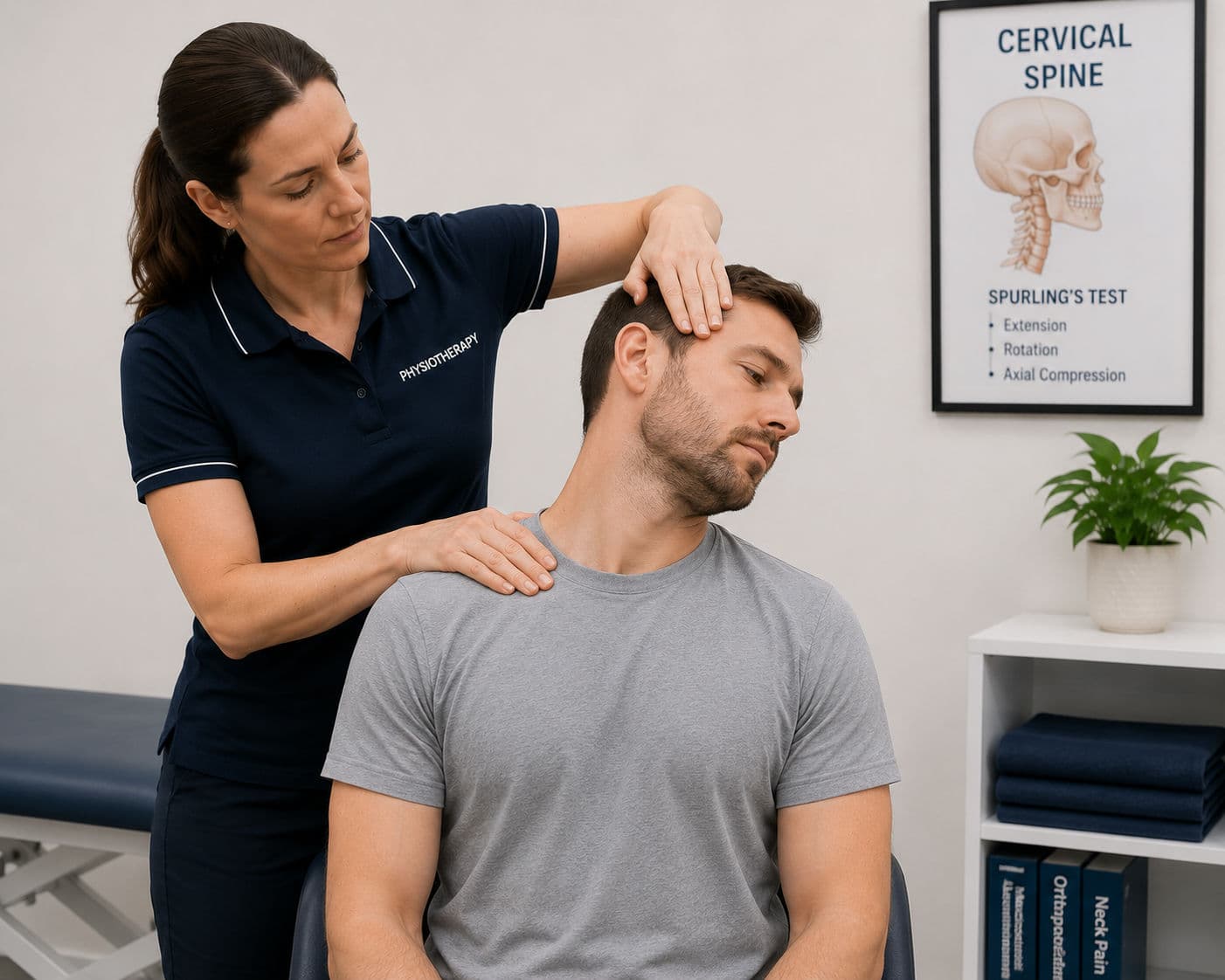
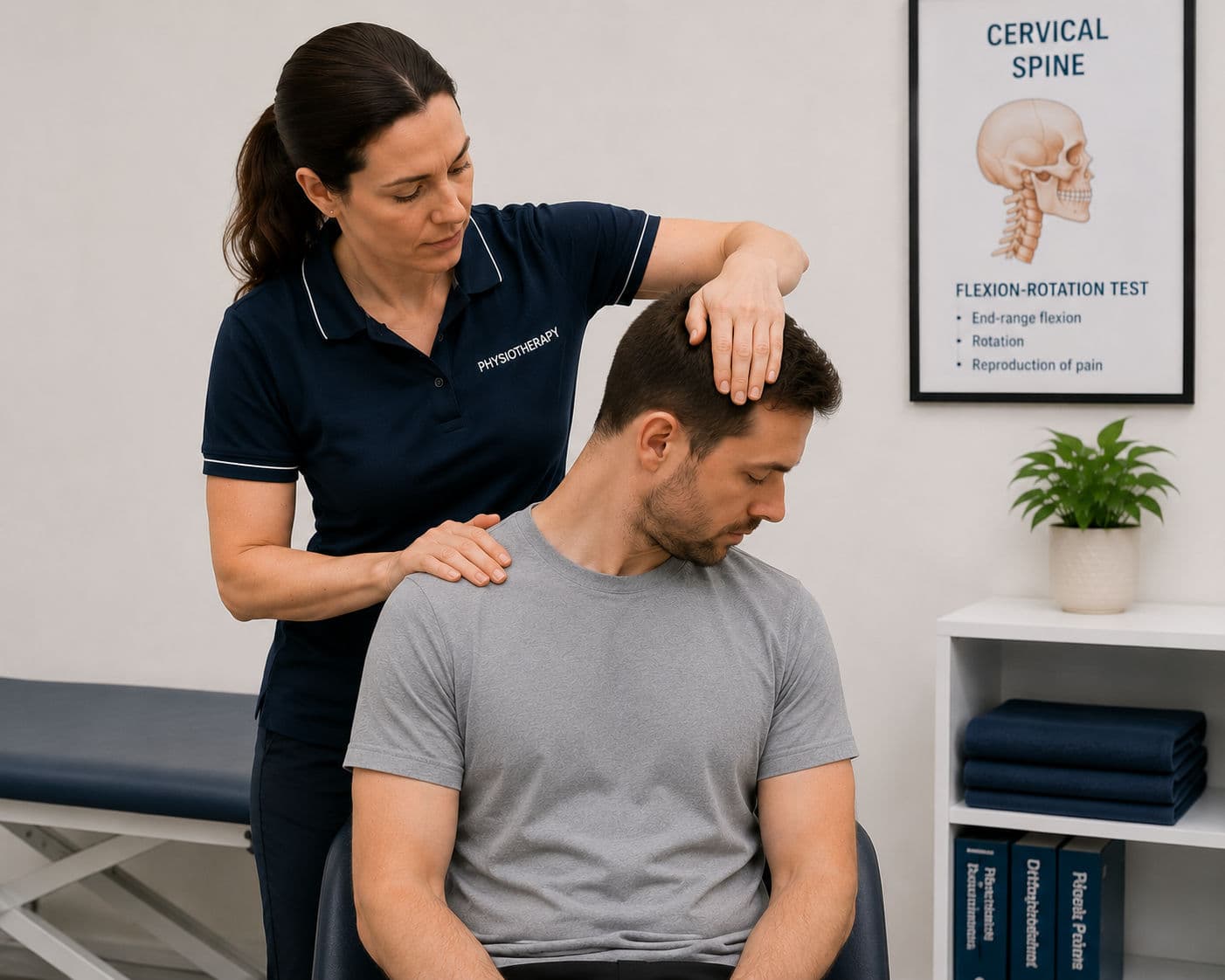
The cervical flexion-rotation test is a valuable adjunct in identifying upper cervical involvement, specifically at the C1-C2 segment, which contributes the majority of rotation in the cervical spine. The test is performed by passively holding the neck in full flexion, which is intended to constrain rotation largely to the C1-C2 level, and then rotating the head to each side until resistance or symptom onset. The test is considered positive when the estimated range is reduced by more than approximately 10 degrees from the expected normal range of around 44 degrees, and the side of greatest restriction typically corresponds to the symptomatic side. The test has been reported to have high sensitivity and specificity, on the order of 90 per cent, for identifying C1-C2-related cervicogenic headache, which makes it a useful component of the differential examination.
What Does the Evidence Recommend for Treatment?
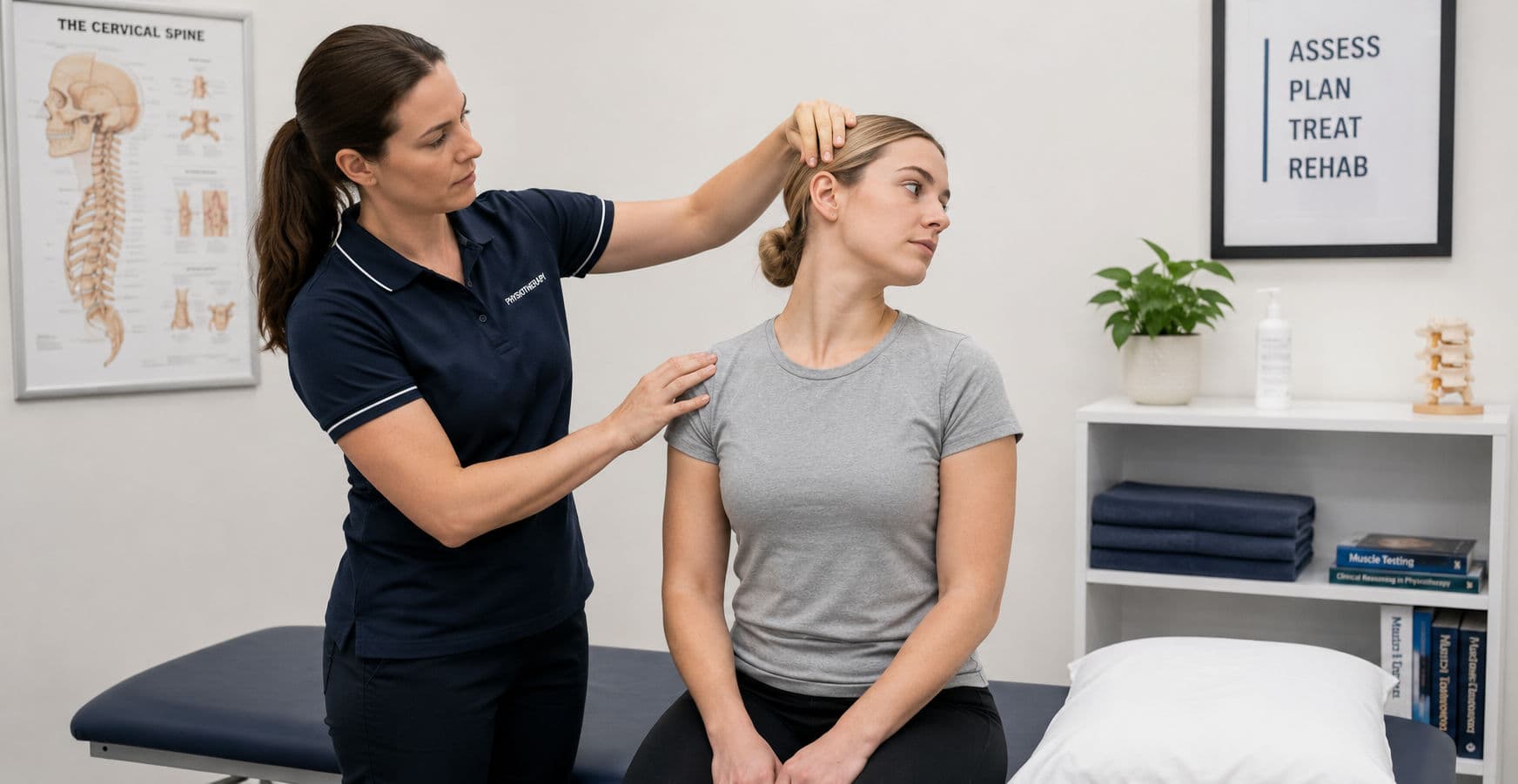
Because the source is musculoskeletal, cervicogenic headache responds to physical treatment directed at the cervical spine. The evidence supports a combination of manual therapy and exercise. Manual therapy is typically directed at the hypomobile upper cervical segments, while exercise addresses the deep cervical flexors through craniocervical flexion training, together with strengthening of the cervicoscapular musculature and correction of contributing postural factors. Systematic reviews of manual and exercise therapy report reductions in headache intensity and frequency, and current guidance supports the use of exercise therapy and spinal manipulation or mobilisation for this purpose. As with other cervical presentations, the durable benefit derives from active rehabilitation; manual therapy serves to reduce pain and restore segmental movement so that the patient can engage with the exercise programme. Interventional procedures, such as diagnostic and therapeutic nerve blocks, are reserved for selected cases and fall outside first-line conservative management.
When Should Cervicogenic Headache Prompt Further Assessment?
The clinician must remain alert to features that fall outside a straightforward musculoskeletal presentation. A sudden, severe, or “worst-ever” headache, a marked change in the pattern of a long-standing headache, a headache accompanied by neurological deficit, fever, or constitutional symptoms, and any suggestion of vascular compromise all warrant prompt medical assessment rather than continued physical treatment. A headache that does not improve as expected with appropriate cervical treatment should likewise prompt reconsideration of the diagnosis.
What Self-Management and Prognostic Messages Support Recovery?
Sustained improvement in cervicogenic headache depends substantially on what the patient does between consultations.
- Because the headache is provoked by neck movement and sustained posture, addressing the daily postural load is integral to management rather than incidental to it.
- Patients who spend long periods in sustained flexion, whether at a desk, a workstation, or a handheld device, benefit from practical strategies to vary position and to interrupt prolonged static postures.
- A home programme of craniocervical flexion exercise, prescribed at a tolerable intensity and progressed gradually, builds the endurance of the deep cervical flexors that support the upper cervical segments.
- Cervicogenic headache that is correctly identified and treated with manual therapy and exercise tends to improve in both frequency and intensity, though the course is measured in weeks rather than days.
- As with other cervical presentations, the durable change follows from active rehabilitation, and the clinician should frame manual therapy as a means of enabling that rehabilitation rather than as a treatment to be repeated indefinitely.
- Recurrence is possible, particularly where the provoking postural factors return, so equipping the patient to recognise early symptoms and to resume their self-management is a worthwhile component of care.
KineticFlow for Cervicogenic Headache Assessment
KineticFlow helps you:
- Document the differential reasoning: The features distinguishing cervicogenic headache from migraine and tension-type headache are recorded, so the basis for the diagnosis is explicit.
- Capture the flexion-rotation test: The side and degree of restriction are stored, supporting identification of upper cervical involvement and tracking of change.
- Track headache burden over time: Headache frequency and intensity are recorded at each visit, demonstrating whether manual therapy and exercise are reducing the burden.
- Flag atypical features: Documented prompts for headache red flags support timely referral when the presentation falls outside a cervical source.
Try KineticFlow for your next patient assessment!
References
https://my.clevelandclinic.org/health/diseases/cervicogenic-headache
https://www.ncbi.nlm.nih.gov/books/NBK507862/
https://www.sciencedirect.com/science/article/abs/pii/S1356689X06001111