Scapular Dyskinesis: Evidence-Based Treatment and Corrective Exercise Progression
Scapular dyskinesis divides clinical opinion, as some treat it as the root cause of shoulder problems, while others treat it as a normal variation. The evidence sits between the two.
Scapular dyskinesis divides clinical opinion, as some treat it as the root cause of shoulder problems, while others treat it as a normal variation. The evidence sits between the two. As per research consensus, it is common in shoulder injury, but it is an impairment to assess and address when relevant, not a diagnosis in itself. This post summarises the supporting evidence and sets out a practical three-stage corrective exercise progression.
What is Scapular Dyskinesis?
Scapular dyskinesis is an observable alteration in the resting position or the movement of the scapula during arm elevation and lowering. Common expressions include medial border prominence, early or excessive scapular elevation, and dysrhythmia through the movement arc. Proposed contributors, summarised in a review, include:
- Weakness or altered activation of the serratus anterior and lower trapezius, often with overactivity of the upper trapezius.
- Tightness of the pectoralis minor and the posterior shoulder.
- Pain itself alters muscle activation. Dyskinesis can be a consequence of a shoulder problem as easily as a cause.
- Less commonly, neurological causes such as long thoracic nerve palsy must not be missed.
The Critical Caveats Before You Treat Scapular Dyskinesis
Three findings keep treatment honest:
- Dyskinesis is common in completely asymptomatic people, especially overhead athletes. Its presence alone is not an abnormality that demands correction.
- The relationship between scapular position and subacromial pain is inconsistent. A systematic review of scapular orientation and subacromial impingement found the evidence for a consistent association to be conflicting.
- The consensus position is that dyskinesis is best viewed as a potential impairment of shoulder function, particularly relevant in impingement-type presentations, rather than an injury category.
- The practical rule: treat scapular dyskinesis when it is observable and when modifying it changes the patient’s symptoms. Otherwise, leave it alone.
What are the Causes of Scapular Dyskinesis?
One question reframes the whole assessment: is the dyskinesis driving the shoulder problem, or is the shoulder problem driving the dyskinesis? Both happen, and the answer changes the emphasis of treatment.
- Dyskinesis as a contributor: In an overhead athlete with gradual-onset pain and clear scapular muscle weakness, addressing scapular control may be central to recovery.
- Dyskinesis as a consequence: Pain inhibits and alters muscle activation. A painful cuff or a stiff thoracic spine can produce altered scapular movement that resolves once the primary problem is treated. Here, chasing the scapula directly is a distraction.
You rarely know the answer at the first visit, which is why the symptom-modification tests matter so much. If stabilising or assisting the scapula immediately changes the patient’s pain or strength, the scapula is worth targeting. If it changes nothing, your attention belongs elsewhere, and the dyskinesis can be left to settle as the primary driver is addressed.
How to Assess a Patient With Scapular Dyskinesis?
- Observe: Watch repeated, loaded arm elevation and lowering from behind. Rate dyskinesis as present or absent; complex typing systems have poor reliability.
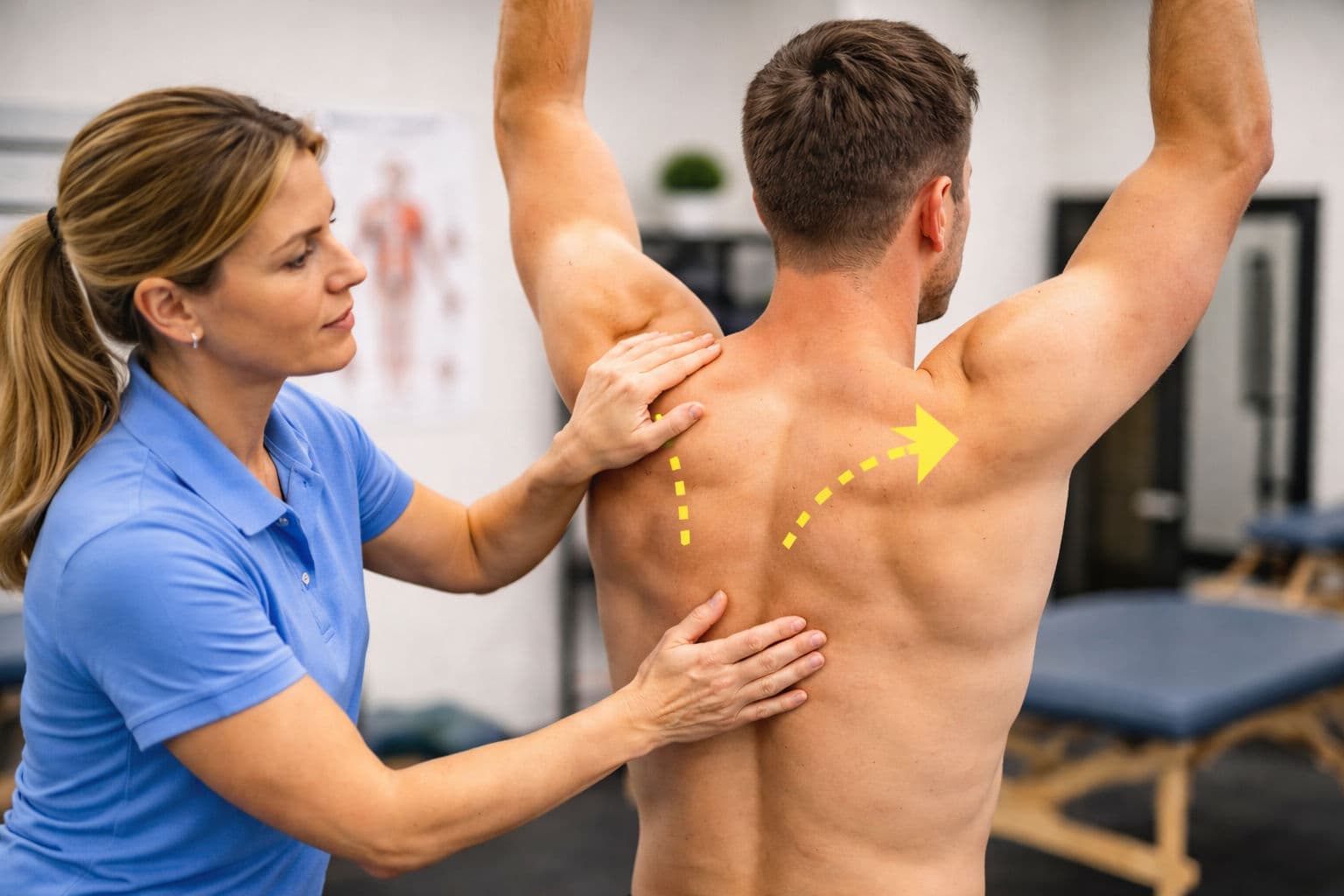
- Test relevance with symptom modification: In the scapular assistance test, manually assist upward rotation during elevation. In the scapular retraction test, stabilise the scapula and re-test strength or a painful movement. A meaningful improvement in symptoms links the impairment to the problem.
- Screen the drivers: Assess pectoralis minor flexibility, posterior shoulder tightness, thoracic mobility and the strength of the scapular muscles.
Evidence for Scapular-Focused Exercise
Scapular-focused exercise programmes improve pain and function in people with subacromial-type shoulder pain, at least in the short term, and they are consistently recommended within multimodal rehabilitation. Reviews of scapular-focused treatment approaches support targeted exercise, with stretching of tight anterior structures as an adjunct. Load, graded exposure and confidence plausibly do much of the work. You should prescribe the exercise and keep the expectations realistic, which includes:
- Much of the supporting evidence pairs scapular work with general shoulder rehabilitation, so it is difficult to isolate how much the scapular-specific component contributes on its own.
- Normalising the observed movement pattern is not a reliable marker of success; symptoms and function improve in many patients whose scapular appearance changes little. The takeaway is to judge the programme by what happens to the patient’s pain and capacity, not by whether the scapula starts to look textbook-perfect.
A Three-Stage Corrective Exercise Progression
Stage 1: Conscious Control and Activation
- Aim: Re-establish awareness of scapular position and selective activation of the under-performing muscles, with low load.
- Scapular orientation drills: gentle posterior tilt and upward rotation cues in sitting, then in four-point kneeling.
- Low-load activation work biased toward serratus anterior and lower trapezius, such as supported punches, side-lying external rotation and prone arm lifts, with minimal upper trapezius dominance.
- Address flexibility deficits in parallel: pectoralis minor stretching and posterior shoulder stretching, such as the cross-body stretch.
- Progress when: The patient can find and hold a corrected scapular position during simple arm movements without cueing.
Stage 2: Strength and Endurance Under Load
- Aim: Build capacity in the scapular muscles and integrate control into progressively heavier patterns.
- Serratus-biased loading: wall slides, push-up plus progressions, and loaded punches.
- Trapezius and retractor loading: rows, low rows, prone Ys and Ts, progressing load and lever.
- Integrate with rotator cuff strengthening in functional ranges.
- Train endurance as well as strength; postural muscles fail by fatigue, so include higher-repetition sets.
- Progress when: Loaded patterns are performed with maintained control, without symptom flare, and strength is approaching the demands of the patient’s goals.
Stage 3: Kinetic Chain and Task Integration
- Aim: Transfer control into the speeds, loads and positions that the patient actually needs.
- Integrate the legs and trunk: split-stance presses, cable patterns and lifting tasks that link the kinetic chain to the shoulder.
- Overhead progressions for overhead workers and athletes, building range and load gradually.
- For athletes, add plyometric and sport-specific drills such as throwing progressions, performed with monitored workload.
- Discharge when: Symptoms are resolved or manageable, capacity meets task demands, and the patient runs the programme independently. The scapula does not need to look perfect; the shoulder needs to perform.
Dosing and Practical Principles
The stages above describe direction, not dose. A few principles make the difference between a programme that works and one that stalls:
- Dose for adaptation: Treat the scapular muscles like any other muscle group. Meaningful change needs progressive load over weeks to months, not a handful of light activation drills repeated indefinitely.
- Prioritise the few exercises that matter: Two or three well-chosen, well-progressed exercises that the patient will actually do beat a long sheet they abandon. Adherence is the active ingredient.
- Pair loading with flexibility where indicated: If pectoralis minor or the posterior shoulder is genuinely tight, stretching alongside strengthening removes a mechanical brake on motion.
- Let symptoms, not appearance, guide progression: Advance when control holds, and symptoms allow. Chasing a textbook scapular rhythm for its own sake is not a goal worth pursuing.
What if Scapula Is Not the Answer?
Because dyskinesis is so visible, it is easy to over-attribute. Re-examine your reasoning if:
- The symptom-modification tests did not change the patient’s pain. If correcting the scapula does nothing to symptoms, the scapula is unlikely to be the driver.
- Progress stalls despite good adherence and sensible loading. Revisit the primary diagnosis, the load history, and the contributing factors rather than simply adding more scapular drills.
- There are neurological features. Pronounced, fixed winging, especially with a relevant history, should prompt consideration of long thoracic or accessory nerve involvement and appropriate onward investigation.
Used this way, scapular rehabilitation is a valuable tool deployed on evidence rather than reflex, which is exactly what the consensus intended.
KineticFlow For Scapular Dyskinesis Treatment
KineticFlow helps you:
- Document the relevance test: Symptom-modification findings are recorded, so the decision to target the scapula is evidence in the record rather than habit.
- Gate the progression on control: Stage criteria sit alongside the programme, making advancement a documented decision.
- Trend strength and symptoms together: Pain, function and capacity scores are tracked over time, showing whether the programme is actually working.
- Avoid treating the irrelevant: When dyskinesis is documented as present but not symptom-linked, the record protects you from chasing a finding that does not matter.
In a debate full of strong opinions, KineticFlow keeps your scapular management anchored to findings, criteria and response.
Try KineticFlow for your next shoulder rehabilitation plan!
References
https://ik.imagekit.io/assistencialabs/blog/content/47/14/877
https://pubmed.ncbi.nlm.nih.gov/23580420/
https://pubmed.ncbi.nlm.nih.gov/19996329/
https://ik.imagekit.io/assistencialabs/blog/content/48/16/1251
https://pubmed.ncbi.nlm.nih.gov/37003662/
https://ik.imagekit.io/assistencialabs/blog/content/46/14/964