Gluteal Tendinopathy (GTPS): Assessment and Progressive Loading
Although the condition was long labelled trochanteric bursitis, the dominant pathology is a tendinopathy of the gluteus medius and minimus rather than a primary bursitis.
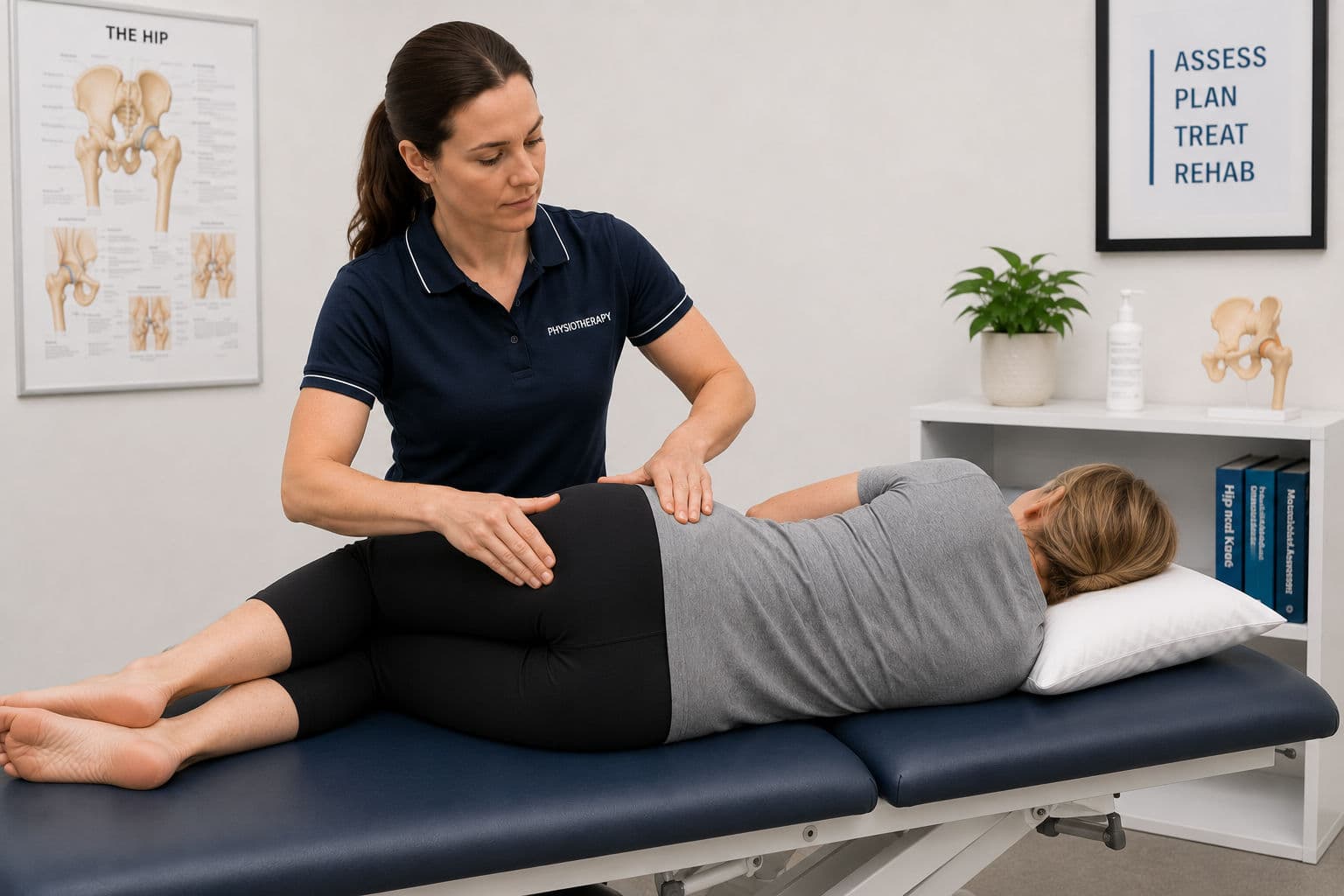
Gluteal tendinopathy is the most common cause of greater trochanteric pain syndrome and a frequent source of lateral hip pain in clinical practice, particularly in women in the fifth and sixth decades. Although the condition was long labelled trochanteric bursitis, the dominant pathology is a tendinopathy of the gluteus medius and minimus rather than a primary bursitis. The distinction matters, because it reframes management away from anti-inflammatory measures and toward graded mechanical loading. This article sets out the clinical presentation, the assessment that discriminates gluteal tendinopathy from its mimics, and the staged loading approach supported by the contemporary evidence.
What Is Gluteal Tendinopathy?
Gluteal tendinopathy is a load-related disorder of the gluteus medius and minimus tendons where they insert onto the greater trochanter. As per modern imaging and surgical findings, the lateral hip pain once attributed to bursitis is, in most cases, an abductor tendinopathy, and any bursal distension is a secondary or concomitant finding rather than the primary problem.
The mechanics are now well described. Compressive load is generated when the iliotibial band is drawn against the greater trochanter as the hip moves into adduction. Superimposed on the tensile load the tendon already carries, this compression is implicated in both the development and the persistence of the tendinopathy. Certain positions, therefore, combine compression with load and are characteristically provocative: sitting with the legs crossed, standing with the weight shifted onto one hip, and side-lying on the affected side.
How Does It Present, and Who Is Affected?
The pain and tenderness are localised to or around the greater trochanter and often radiate down the lateral thigh. Sleep is commonly disturbed when the patient lies on the affected side. Symptoms are typically aggravated by weight-bearing activities such as walking and stair climbing, by prolonged sitting, and by single-leg loading.
The disorder is most prevalent in women between forty and sixty years of age. Its impact is substantial. The reported levels of disability and reduced quality of life are comparable to those of severe hip osteoarthritis. Recognising this burden is part of effective management, since patients often arrive having been told the problem is trivial.
How Is Gluteal Tendinopathy Assessed?
Assessment is primarily clinical. Palpation reproduces pain over the greater trochanter, and a cluster of loading tests supports the diagnosis. Pain on single-leg stance, held for around thirty seconds, is a useful discriminator; this pain-provocation version of the test has high specificity, though its sensitivity is limited. Resisted hip abduction is also used, along with tests that load the tendon in a lengthened, compressed position by combining flexion, abduction, and external rotation. A Trendelenburg sign may indicate abductor insufficiency.
Imaging is not required to make the diagnosis. It should be reserved for atypical presentations or when an alternative diagnosis is suspected. Tendon changes are common on the scans of asymptomatic hips, so a positive scan does not, on its own, establish the source of pain.
How Is It Distinguished From Other Causes of Lateral Hip Pain?
The differential diagnosis of lateral hip pain is broad. It includes intra-articular sources such as hip osteoarthritis, femoroacetabular impingement, and labral pathology, and extra-articular sources such as lumbar referred pain and radiculopathy. Several findings help separate them.
Lateral pain reproduced by the flexion-abduction-external-rotation position helps differentiate gluteal tendinopathy from hip osteoarthritis. A patient who can manage shoes and socks without difficulty is less likely to have a significant intra-articular restriction. Restricted passive hip range of motion, particularly internal rotation, points instead toward osteoarthritis or impingement. Where pain radiates beyond the lateral thigh, follows a dermatomal pattern, or is accompanied by neurological signs, a lumbar source should be considered and screened.
What Does the Evidence Recommend for Treatment?
The most informative trial in this area, the LEAP trial, compared a programme of education and exercise with corticosteroid injection and with a wait-and-see approach. Education combined with exercise produced superior global improvement and pain outcomes at eight weeks, and the advantage was maintained at fifty-two weeks. Corticosteroid injection gave useful short-term analgesia but conferred no durable benefit over the conservative comparators.
Education and progressive loading should form the foundation of management. Injection, if used at all, is reserved for short-term symptom relief in selected cases rather than as a definitive solution. The education component is not incidental: advising the patient to avoid the sustained compressive, adducted positions that aggravate the tendon is itself an active part of treatment.
How Should the Loading Programme Be Structured?
The exercise approach progresses through stages. The first priority is load management and education. Provocative compressive positions are reduced, and the patient learns to hold a more neutral hip alignment in standing, sitting, and lying.
Loading then begins. Isometric abduction work is often used first, since it loads the tendon with limited movement and has a useful analgesic effect, before progression to isotonic abductor strengthening through range. Movement is then optimised so that the pelvis is controlled during functional tasks, which addresses the abductor insufficiency that drives compressive load. The final stage introduces higher and more functional loading, including weight-bearing and, where relevant to the patient's goals, energy-storage tasks.
Progression is guided by symptom response within an acceptable range rather than by a fixed timetable. The programme is sustained because tendon adaptation occurs over months rather than weeks.
What Education and Load Management Does the Patient Need?
Education is an active component of treatment, not general advice appended to it. It centres on reducing the sustained compressive positions that load the tendon against the greater trochanter.
- Patients are taught to recognise and modify the habits that provoke their pain: sitting with the legs crossed or the knees together, standing with the weight dropped onto one hip so the pelvis tilts, sleeping on the affected side, and sitting in low, soft chairs that increase hip flexion and adduction.
- Sitting with the knees apart and the hips level with or higher than the knees, placing a pillow between the knees in side-lying or settling onto the less affected side, and avoiding the hip-dropped standing posture all help. These changes reduce the daily compressive load and frequently settle the night pain that patients find most distressing.
- Alongside positional advice, overall load is managed rather than eliminated. The aim is not to stop activity but to grade it, so the tendon remains loaded within its capacity while avoiding provocative spikes.
- A sudden increase in walking, a return to hill or stair work, or a resumption of running after a layoff are common triggers; each benefits from temporary modification and gradual reintroduction once capacity has been rebuilt.
- Reducing compression and grading tensile load together create the conditions in which strengthening can take effect, which is why education is treated as the foundation on which loading is built.
The condition is often dismissed or mislabelled as bursitis. As a result, patients may arrive after a long period of disturbed sleep and curtailed activity, sometimes following repeated injections that gave only temporary relief. Explaining that the dominant problem is a load-related tendinopathy reframes their expectations toward an active plan and away from passive or anti-inflammatory measures.
When Should GTPS Prompt Further Assessment?
Most lateral hip pain is mechanical, but certain features should prompt reconsideration or referral: a history of significant trauma, a sudden loss of abductor power suggesting a substantial tendon tear, constitutional symptoms such as fever or unexplained weight loss, a history of malignancy, or pain that is unremitting and night-dominant beyond the expected pattern. Likewise, a presentation that fails to respond to an appropriate period of well-executed loading should prompt review of the diagnosis rather than indefinite continuation of the same programme.
What Is the Prognosis, and What Supports Recovery?
The prognosis with education and progressive loading is favourable. The majority of patients improve, and that improvement is maintained at one year. Recovery is gradual, and setting this expectation at the outset supports adherence; patients who anticipate a rapid resolution may disengage when progress is measured in months. The durable change comes from the patient's sustained loading and modified daily habits, so equipping them to manage compressive load independently is central. Recurrence is possible if provocative loads return without adequate tendon capacity, which is why the programme aims to build and then maintain abductor strength rather than simply to settle the current episode.
KineticFlow for Gluteal Tendinopathy
KineticFlow helps you:
- Record the discriminating assessment: The loading tests and palpation findings that separate gluteal tendinopathy from osteoarthritis and lumbar referral are documented together, so the basis for the diagnosis is explicit.
- Stage the loading programme: The progression from load management through isometric and isotonic loading to functional tasks is tracked, so the current stage and the criteria for advancing are clear.
- Track outcomes against baseline: Pain and function scores are stored at each visit, demonstrating whether the chosen approach is producing meaningful change over the months that tendon adaptation requires.
- Surface red flags early: Documented screening prompts ensure that features warranting further assessment are not overlooked in a busy clinic.
Try KineticFlow for your next patient assessment!
References
https://pmc.ncbi.nlm.nih.gov/articles/PMC5930290/
https://www.ncbi.nlm.nih.gov/books/NBK557433/
https://pmc.ncbi.nlm.nih.gov/articles/PMC8182177/
https://www.sciencedirect.com/science/article/pii/S2468781225000013